Cycling in Japan: Staying safe during Emergencies

I’ve been meaning to write this article ever since the Noto Earthquake on New Year’s Day 2024. I was in Kanazawa (near Noto) at my in-laws old and rather rickety family home when the ground started to shake and the alarms started to ring. Diving under the table during the initial shakes before we quickly decided to make the kilometre walk back to the hotel. As we were leaving the TV was on, and the announcers were screaming evacuate (Hinan) and escape (Nigaro) as the map on the TV flashed with warnings and concerns about a pending Tsunami. Turning the TV off and the gas, we made our way to the KKR Kanazawa Hotel.
Waiting in the hotel lobby with all other guests, it was clear to see the staff had been drilled for such eventualities and plans were in place for dealing with emergencies. While waiting in the lobby, I began to wonder how prepared cyclists visiting Japan were for dealing with emergencies, especially those on longer bikepacking and biketouring adventures, going into remote parts of Japan.
Yesterday, the Kumamoto earthquake struck. The time is now.
A quiet mountain road in Japan can feel wonderfully remote until your phone sounds an emergency alert. The good news is that disaster preparedness during bike touring Japan does not require carrying expedition-level gear or riding nervously. It means understanding the hazards that affect your route, setting up a few reliable systems before departure, and knowing when the smartest move is simply to stop.
Japan is exceptionally organized in emergencies, but the systems work best when you can receive alerts, keep your phone charged, and make calm decisions early. For cyclists, the central rule is simple: do not try to preserve the day’s route when conditions are telling you to get off the road.
Prepare Before the First Pedal Stroke
Start with the bike setup. A properly maintained touring bike, dependable tires, working lights, and secure panniers matter every day, but they matter more when you need to change plans quickly. Keep rain layers, a warm layer, and a compact first-aid kit where you can reach them without unpacking everything at the roadside.
Your phone is the most useful piece of emergency equipment you will carry. Arrive with mobile data through an eSIM, local SIM, or portable Wi-Fi arrangement that works beyond major cities. Download offline maps for each region you plan to ride, save accommodation details in both English and Japanese where possible, and carry a power bank. A fully charged phone is not just for navigation. It is how you receive weather alerts, check train disruptions, locate lodging, and communicate with your rental provider, travel companions, or family.
Before a multi-day ride, tell someone your planned route and likely overnight stops. This does not need to be a rigid itinerary. A basic message such as “riding from Onomichi to Imabari, staying near Matsuyama tomorrow” gives another person a useful starting point if you fail to check in.
Keep a small amount of cash in separate places. Cards are widely accepted, especially in cities, but a storm-related power outage or a rural vending machine is a reminder that cash remains practical in Japan. Carry identification, travel insurance details, and a short medical information card with allergies, medications, and an emergency contact.
Know the Main Risks on a Japanese Cycling Route
The risk changes significantly by season and location. A spring ride through Kansai, a summer crossing of Shikoku, and an autumn tour in Tohoku should not be planned the same way.
Earthquakes
Earthquakes can happen anywhere in Japan and without warning. If you are riding and feel strong shaking, slow down, stop in a safe open area, and move away from walls, utility poles, overhead signs, bridges, steep slopes, and anything that may fall. Do not stop under an elevated roadway or inside a tunnel unless there is no safer immediate option.
If you are indoors at a cafe, hotel, convenience store, or station, follow staff instructions. Protect your head, stay away from windows, and do not rush outside during the shaking. Once it stops, check official alerts and expect transport disruptions, closed roads, and aftershocks. A bike can be an advantage when trains stop running, but only if roads have been confirmed safe and you are not riding into a restricted area.
Tsunami Risk on Coastal Routes
Cyclists on coastal routes should take tsunami warnings seriously, especially after a strong or long earthquake. This applies to shoreline areas around the Seto Inland Sea, Pacific coast, Izu Peninsula, parts of Kyushu, and many other excellent touring regions.
If a tsunami warning is issued, leave the coast immediately and head for higher ground or a designated evacuation building. Do not pause to photograph the sea, return for a bike left behind, or wait to see what other people do. Your bike is replaceable. Move first, then follow local instructions. In Japan, evacuation routes and shelter signs are often clearly marked, but recognizing them before an emergency is far easier than trying to interpret them under pressure.
Typhoons, Heavy Rain, and Landslides
Typhoon season generally peaks from late summer into early fall, though heavy rain can affect travel at other times. A typhoon is not merely a wet riding day. Strong winds can push a cyclist into traffic, send branches onto roads, close bridges, and create dangerous conditions on exposed coastal sections.
Heavy rainfall also raises the risk of landslides and flooding, particularly on mountain roads, forested valleys, and narrow routes beside rivers. Do not ride around barriers, even if the road looks passable from your side. Japanese closures may be in place because the danger lies farther ahead, such as a washed-out section, falling rocks, or an unstable slope.
When a major rain system is forecast, book or remain in accommodation early rather than trying to outrun it. This is one of the clearest cases where flexibility beats fitness. A rest day in Kyoto or an extra night in a small Shikoku town is a much better touring story than an avoidable rescue or crash.
Heat, Cold, and Snow
Heat is one of the most common hazards for overseas riders. Japanese summers combine high temperatures, humidity, and long stretches of sun that can make even a modest route feel punishing. Start early, refill water often, use convenience stores as cooling stops, and include electrolytes rather than relying on plain water alone. If you develop headache, nausea, chills, confusion, or unusual weakness, stop riding, get into air conditioning, and seek help.
Winter touring has a different set of decisions. Mountain passes, northern regions, and high-elevation roads can hold snow and ice well after conditions look clear in the city. Studying elevation matters as much as checking the forecast. If you are unsure whether a pass is open or safe, choose a lower route or use public transportation for that section.
Build a Daily Go or No-Go Routine
Each morning, take two minutes to check the weather forecast, warnings, and route conditions before loading the panniers. Pay special attention to wind direction and speed, thunderstorm timing, rainfall totals, and notices for your prefecture. A bright morning does not guarantee a safe afternoon in the mountains.
Give yourself a decision point before any remote section. For example, before climbing into a valley with limited services, ask whether you have enough water, battery, daylight, and weather margin to complete it. If the answer is no, do not negotiate with yourself halfway up the climb. Change the plan while there is still an easy alternative.
Japan’s convenience stores, train stations, roadside rest areas, hotels, and larger supermarkets are valuable places to pause, recharge, buy food, and ask for help. In a storm or heat emergency, they are often better immediate options than pushing onward to a scenic but isolated campground.
What to Carry Without Overpacking
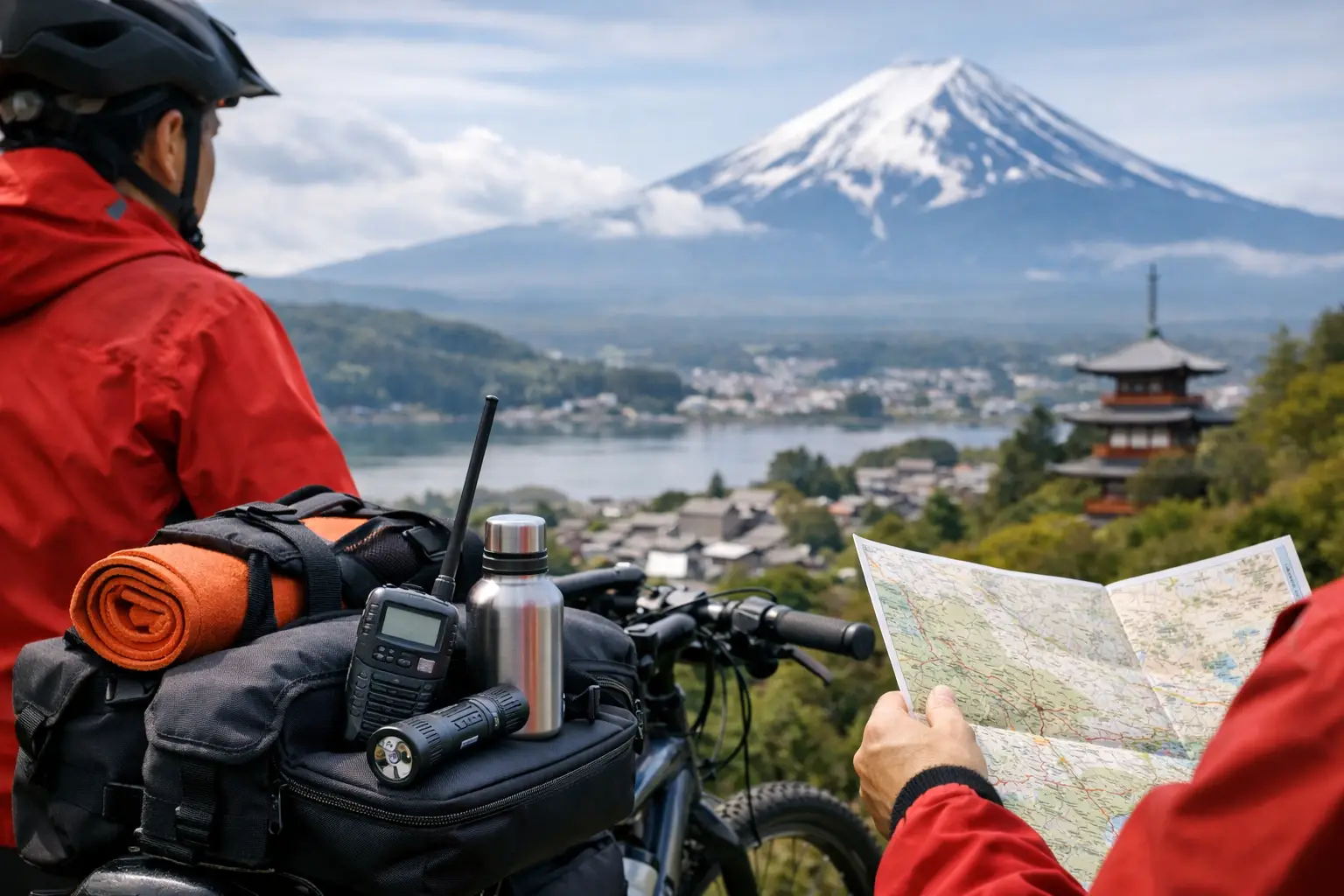
Touring preparedness is about useful redundancy, not filling every pannier. Alongside normal repair tools and spare tubes, carry a charged power bank, compact rain jacket and pants, insulated or warm layer suited to the season, basic first aid supplies, emergency snacks, water capacity for your longest planned gap between stops, and a small headlamp.
Add a paper note with your accommodation address, emergency contact, and key Japanese phrases. Even if you use translation software, a written address helps when your battery is low or another person needs to assist you. Useful phrases include “I need help,” “I need a hospital,” and “Where is the evacuation shelter?”
Learn the emergency numbers before departure: 110 for police and 119 for fire or ambulance services. If there is a serious injury, do not attempt to ride to the nearest clinic just because you have a bike. Call for help or ask a nearby business, hotel, or passerby to assist.
Use Local Knowledge Before You Commit to the Route
A route that looks ideal on a cycling app may be poorly suited to current conditions. Small roads can be beautiful and quiet, but they may also have limited lighting, little traffic, weak cell coverage, or no quick alternative if weather turns. That is not a reason to avoid them. It is a reason to ride them with more daylight, more battery, and a clear exit plan.
When collecting a rental bike, ask about the day’s weather concerns, seasonal road conditions, and sensible alternatives for your intended route. Road Bike Rental Japan can help riders begin with a professionally prepared bike, touring equipment, and practical route support, but the final advantage comes from staying responsive once you are out on the road.
The best prepared cyclist is not the one carrying the most gear. It is the rider willing to trade one planned climb, one booked night, or one photo stop for a safer decision. Japan rewards that flexibility with plenty of good roads still waiting tomorrow.
