
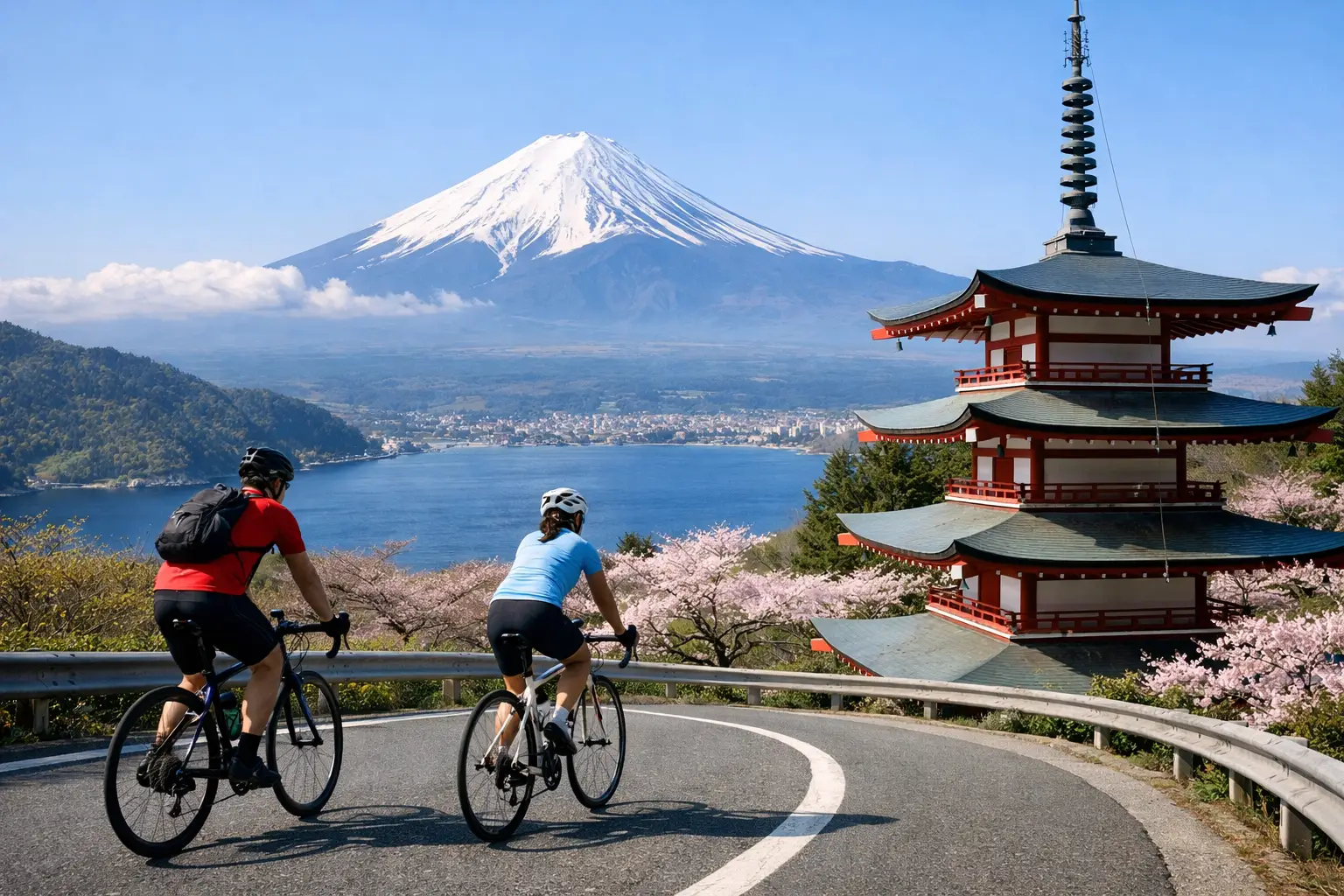
Japan rewards riders who leave the big cities behind. The best Japan cycling holiday routes link quiet farming towns, mountain passes, coastlines, temple districts, and small ferry ports in a way that cars and rail travel simply cannot. You can ride hard on a carbon road bike, travel slowly with panniers, or combine both approaches on a multi-day trip.
The right route depends less on a single fitness level than on the kind of day you want: long climbs and empty mountain roads, relaxed island hopping, or a cultural ride with frequent stops. Japan’s rail network makes point-to-point planning possible, but bike rules, luggage space, and limited rural services mean a little preparation goes a long way.
7 Best Japan Cycling Holiday Routes
1. Shimanami Kaido: Onomichi to Imabari
For many first-time cycling visitors, Shimanami Kaido is the obvious place to start – and for good reason. This celebrated 43-mile route crosses six islands in the Seto Inland Sea, linking Onomichi on Honshu with Imabari on Shikoku. Dedicated cycling lanes, well-marked approaches to bridges, frequent cafés, and sea views make it unusually approachable for an independent overseas traveler.
Strong riders can complete it in one day, but two days is usually the better holiday choice. It leaves time for a detour into citrus groves, a local lunch, and the smaller roads that hug island shores rather than rushing from bridge to bridge. The main trade-off is exposure: bridge ramps add up, and wind across the water can turn an easy-looking day into a demanding one.
Onomichi is especially practical for a rental start, while Imabari works well for continuing into Shikoku. Road Bike Rental Japan can help riders select a road or touring setup, add panniers and GPS, and plan a pickup or return arrangement that fits the rest of the trip.
2. Lake Biwa: A Big Lake Loop Near Kyoto
Lake Biwa offers one of Japan’s most useful cycling holidays because it pairs open-water riding with easy access from Kyoto and Osaka. A full loop is roughly 125 miles, though most travelers should split it over two or three days. The northern half feels quieter and more rural, with fishing villages, lakeside shrines, and long views toward the mountains.
The southern shore is flatter and busier, making it a sensible warm-up section or a shorter day ride. The north has more character but also more rolling terrain and fewer immediate services. Spring and fall are ideal; midsummer heat and humidity can be punishing around the lake, especially on exposed roads.
A clockwise route often puts the lake on your left for much of the way, but direction matters less than your overnight plan. Reserve lodging in advance around the quieter north shore, particularly on weekends and during cherry blossom or autumn foliage seasons.
3. Kyoto to Nara: Temples, Back Roads, and Tea Country
Kyoto and Nara are often treated as train-and-walk destinations. By bike, the countryside between them becomes the main attraction. A route via Uji and Wazuka can run from about 45 to 65 miles depending on detours, taking riders through tea-growing hills, river valleys, and historic towns before arriving in Nara.
This is not the route for chasing a personal best. Traffic and intersections on the way out of Kyoto require attention, while the tea country brings short, steep climbs and narrow lanes. But it is an excellent one- or two-day cultural ride for cyclists who want a deeper experience than a direct transit connection.
Start early to get through urban sections before traffic builds. A compact climbing gear range is worthwhile, even for experienced riders, since the steepest ramps arrive without much warning. It also pays to carry cash and snacks: rural shops may keep limited hours, especially outside peak tourist periods.
4. Izu Peninsula: Japan’s Classic Coastal Climbing Weekend
Southwest of Tokyo, the Izu Peninsula is a compact road-cycling escape with Pacific Ocean scenery, hot springs, and serious elevation. Riders can build a two- to four-day route from Atami, Mishima, or Ito, combining coastal roads with climbs toward Shuzenji, Amagi Pass, and the peninsula’s less-developed southern end.
Izu is best suited to confident road riders. The terrain is rarely flat for long, road surfaces and tunnel conditions vary, and coastal highways can be busy near popular resort areas. In return, the peninsula delivers the kind of ride many visitors do not expect from Japan: switchbacks above the sea, volcanic landscapes, and long descents into fishing villages.
Avoid trying to cover the entire peninsula too quickly. A shorter itinerary with one major climb per day gives you time for an onsen stop and keeps fatigue from turning technical descents into a risk. Late spring and autumn are usually the sweet spots, while winter can be clear but cold in the interior.
5. Hokkaido: Furano, Biei, and the Central Highlands
Hokkaido offers space on a scale that surprises riders accustomed to Japan’s crowded cities. Around Furano and Biei, wide roads run through patchwork farmland, rolling hills, and mountain backdrops. A three- to six-day holiday can connect Asahikawa, Biei, Furano, and nearby passes, with daily distances tailored from relaxed 30-mile rides to full road-bike days over 75 miles.
The appeal is not technical difficulty so much as rhythm. Traffic is generally lighter, sight lines are longer, and the weather can be far more comfortable than central Japan in summer. The trade-off is distance between services. Carry food, water, a repair kit, and a charged phone, because convenience stores are not always waiting around the next bend.
June through September is the primary riding season. Early summer brings green fields and long daylight; July flower season is beautiful but busier; September can be crisp and calm. Weather changes quickly in the mountains, so pack a light rain layer even when the forecast looks friendly.
6. Kyushu’s Yamanami Highway: Volcanoes and High Plateaus
For a route with climbing, dramatic geology, and rewarding hot-spring towns, head to central Kyushu. The Yamanami Highway area between Yufuin, Kusu, and Aso is one of Japan’s finest mountain-road regions. A sensible holiday route runs three to five days, with climbs across high grasslands and overnight stops where a soak is available after the ride.
This is a route for fit riders who enjoy sustained elevation. Weather is a major planning factor: fog, sudden rain, high winds, and cooler temperatures are common at altitude. Volcanic activity and road conditions can also affect access around Mount Aso, so confirm the current situation before committing to a fixed route.
The reward is a cycling landscape unlike the rest of Japan. You may spend the morning climbing through forest, ride across open plateau in the afternoon, and end the day in a small onsen town. Gearing matters here. A low climbing gear is more valuable than a marginal weight saving.
7. The Kii Peninsula: Kumano Roads and Pacific Coast
The Kii Peninsula, south of Osaka and Kyoto, suits touring cyclists who want spiritual history alongside demanding terrain. Routes can connect Wakayama, Koyasan, Kumano Hongu, Shingu, and the Pacific coast over four to seven days. The roads pass cedar forests, river valleys, pilgrimage sites, and small settlements where the pace feels distinctly removed from Japan’s major cities.
This is not a beginner route. Climbing is constant, roads can be narrow, and rainfall is significant in parts of the peninsula. Yet riders who are comfortable with hills will find an exceptional touring experience, especially when they plan shorter daily distances and book traditional inns along the way.
Use a touring bike or a road bike with enough carrying capacity for layers, tools, and essentials. It is tempting to rely on frequent convenience stores in Japan, but this region has real stretches where planning ahead matters. A GPS route is helpful, though it should never replace checking battery life, weather, and road closures each morning.
How to Choose Your Route and Season
If this is your first cycling trip in Japan, Shimanami Kaido or Lake Biwa offers the easiest logistics. Riders based in Kansai who want culture as much as mileage should consider Kyoto to Nara. For climbing-focused road cycling, Izu and central Kyushu are stronger choices, while Hokkaido works best for riders seeking open roads and summer temperatures that feel less oppressive.
Japan’s best general riding windows are late March through May and October through November, though regional conditions vary. Hokkaido starts later, mountain routes can remain cold well into spring, and typhoon season can affect southern and coastal areas from late summer into early fall. Book accommodations early during holidays, foliage season, and cherry blossom periods.
A well-prepared bike is as valuable as the route itself. Choose tires appropriate to the roads you will actually ride, bring lights for tunnels and late arrivals, and use a lock for café stops. For point-to-point travel, confirm how your bike will be collected or transported before setting off rather than treating the final day as a problem to solve later.
The best route is the one that leaves room for an unplanned bowl of noodles, a roadside shrine, and the small turn toward the sea that was never in the original itinerary. Build those moments into your daily mileage, then enjoy the ride.